SMALL INDOOR
DOG KENNELS & CRATES
Small indoor dog kennels and crates sized for dogs up to 25 lbs. Whether you're crate-training a French Bulldog puppy or need a travel-ready kennel for your Cavalier, every small crate is built to the same standard as our large breed models — just scaled down.
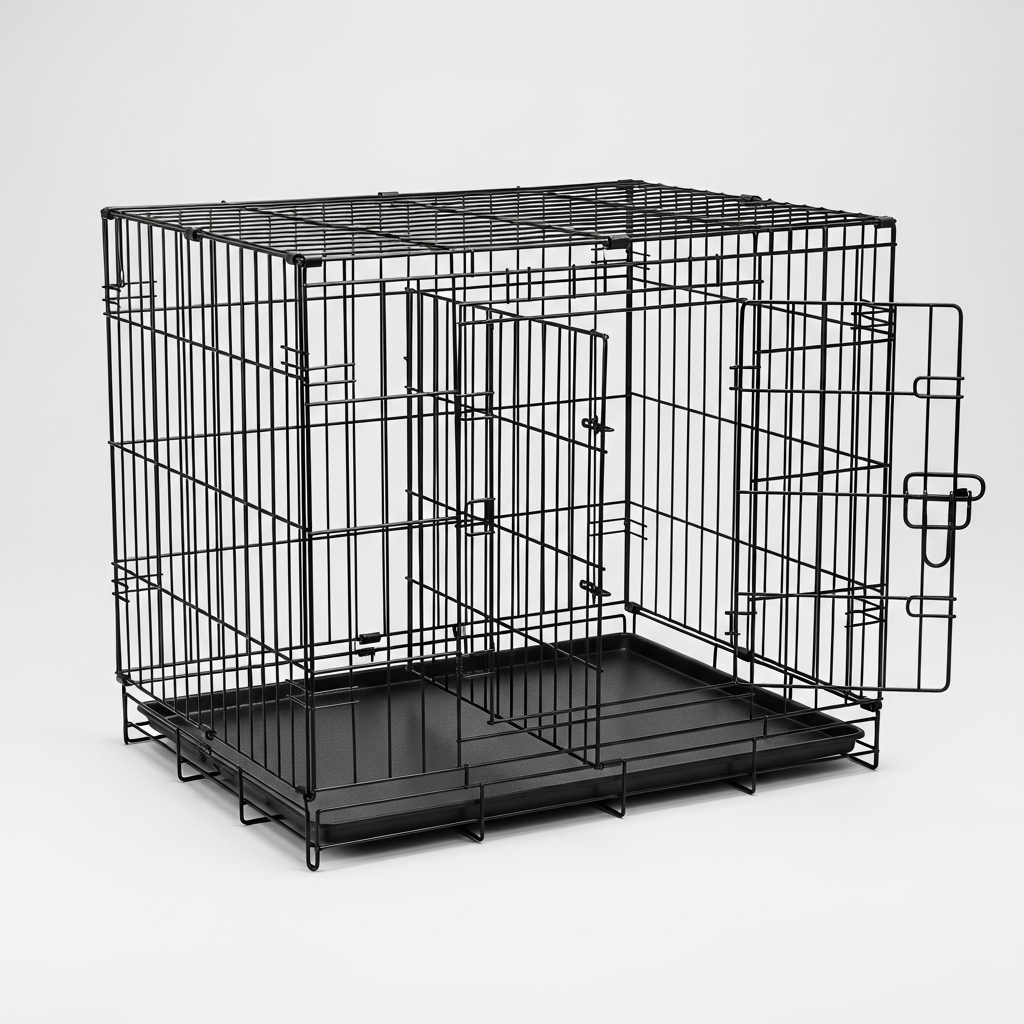 STARTER PICK
FOUNDATION 24" WIRE CRATE
24"L × 18"W × 19"H · 14 lbs · Electro-coated steel
- Adjustable divider included
- Double-door access
- Folds flat for storage
INDOOR DOG KENNEL & CRATE SIZING GUIDE
| Crate Size | Dog Weight | Dimensions | Example Breeds |
|---|---|---|---|
| 24" | Up to 25 lbs | 24"L × 18"W × 19"H | Beagle, French Bulldog, Cavalier King Charles, Miniature Schnauzer |
| 30" | 26–40 lbs | 30"L × 19"W × 21"H | Cocker Spaniel, Shetland Sheepdog, Basenji, Whippet |
| 36" | 41–70 lbs | 36"L × 23"W × 25"H | Border Collie, Bulldog, Australian Shepherd, Springer Spaniel |
| 42" | 71–90 lbs | 42"L × 28"W × 30"H | Labrador Retriever, Golden Retriever, Boxer, Standard Poodle |
| 48" | 91–110 lbs | 48"L × 30"W × 33"H | German Shepherd, Doberman, Rottweiler, Weimaraner |
| 54" | 110+ lbs | 54"L × 37"W × 45"H | Great Dane, Saint Bernard, Mastiff, Irish Wolfhound |
WIRE CRATES
The most versatile indoor dog kennel. Wire crates offer maximum airflow, fold flat for storage, and include adjustable dividers for growing puppies. Ideal for housetraining, everyday containment, and dogs who like to see their surroundings.
- Folds flat for storage
- Adjustable dividers included
- Double-door access
FURNITURE CRATES
Indoor dog kennels that look like furniture. Built with engineered hardwood frames and ventilated steel mesh sides, furniture crates serve as end tables, console tables, or nightstands while giving your dog a proper den space.
- End-table or console design
- Supports 150 lbs on top
- Espresso or white oak finish
HEAVY-DUTY INDOOR
Escape-proof indoor dog kennels for determined dogs. Built from 16-gauge welded steel with multi-point latch systems, heavy-duty kennels end the cycle of replacing cheaper crates your dog destroys or escapes from.
- 16-gauge welded steel
- Multi-point latch system
- Bend-proof and chew-proof
SMALL DOG KENNEL & CRATE FAQ
Common questions about small indoor dog kennels and crates — sizing, features, and what to look for.
Dogs up to 25 lbs typically need a 24" crate (24"L × 18"W × 19"H). This fits breeds like Beagles, French Bulldogs, Cavalier King Charles Spaniels, Miniature Schnauzers, Dachshunds, and Shih Tzus. The crate should be just large enough for your dog to stand up without crouching, turn around fully, and lie down on their side with legs slightly extended. Oversizing a small dog crate actually makes housetraining harder — too much space lets them designate a bathroom corner.
No — if your puppy will grow beyond 25 lbs, buy the adult-size crate now and use the included adjustable divider panel to partition the space. A puppy that will mature into a 60-lb Labrador needs a 42" crate from day one, with the divider moved back every few weeks as they grow. Only use a 24" small crate if your dog's adult weight will stay under 25 lbs.
Small dog crates are one of the best options for apartments. A 24" crate occupies roughly 2 feet × 1.5 feet of floor space — it fits under a desk, in a closet alcove, or beside a nightstand. Wire crates fold flat in seconds when you need the floor space back. For apartments where the crate stays out permanently, a furniture-style crate doubles as an end table and looks better in a living room than an exposed wire crate.
Yes. Small dogs benefit from crates for the same reasons as large dogs — housetraining, safety when unsupervised, travel, and anxiety management. In fact, small dogs are more vulnerable to household hazards like electrical cords, small objects they can swallow, and being stepped on or sat on when loose in the home. A properly sized crate gives your small dog a safe, predictable space of their own.
A washable crate pad or bed that fits the floor dimensions snugly (no bunching), a clip-on water bowl for longer crating periods, and one or two safe chew toys. Avoid loose blankets with puppies or dogs that chew fabric — they're a choking and intestinal blockage risk. For small dogs that run cold (Chihuahuas, Italian Greyhounds), a snug-fitting crate pad with bolster sides provides warmth without the risks of loose bedding.
THE COMPLETE GUIDE TO
INDOOR DOG KENNELS & CRATES
What Is an Indoor Dog Kennel?
An indoor dog kennel — also called a dog crate, indoor crate, or house crate — is a structured enclosure designed for use inside your home. Indoor dog kennels serve multiple purposes: housetraining puppies, providing a safe den space for anxious dogs, preventing destructive behavior when you're away, and giving your dog a place to rest and decompress. Unlike outdoor kennels or dog runs, indoor kennels are built for climate-controlled environments and typically feature either wire, metal, or wood-and-steel hybrid construction. The three main types of indoor dog kennels are wire crates, furniture-style crates, and heavy-duty escape-proof kennels — each engineered for different dogs, living situations, and use cases.
Why Use an Indoor Dog Kennel?
The primary reasons dog owners use indoor kennels fall into four categories: housetraining, safety, anxiety management, and establishing routine. For puppies, an indoor kennel is the single most effective tool for potty training — dogs naturally avoid soiling their sleeping area, so a properly sized crate teaches bladder control. For adult dogs, an indoor kennel prevents destructive chewing, counter-surfing, and access to hazardous items (electrical cords, cleaning products, small objects) when you can't supervise directly.
Dogs with anxiety — whether from separation, noise sensitivity (thunderstorms, fireworks), or environmental triggers — often benefit significantly from having a consistent, enclosed space they associate with safety. Veterinary behaviorists frequently recommend crate training as part of anxiety management protocols. Finally, an indoor dog kennel helps establish daily routine: feeding, napping, and bedtime all become structured events anchored to the kennel, which reduces uncertainty and builds confidence in your dog over time.
Wire Crates vs. Furniture Crates vs. Heavy-Duty Indoor Kennels
Wire dog crates are the most popular type of indoor kennel in the United States. Their open design maximizes ventilation and visibility, they fold flat in seconds for storage or travel, and most include adjustable divider panels for growing puppies. Wire crates work best for standard crate training, everyday containment, and dogs with no escape or destruction tendencies. Price range: $39–$149 depending on size.
Furniture-style dog crates combine a functional indoor kennel with home decor. Built from engineered hardwood with ventilated steel mesh panels, furniture crates double as end tables, nightstands, or console tables. They're ideal for dog owners who want their indoor kennel to be a permanent, visible fixture in the living room or bedroom without the industrial look of wire. Price range: $179–$499 depending on size and finish.
Heavy-duty indoor dog kennels are escape-proof enclosures built from reinforced aluminum or welded steel with multi-point latch systems. These are not luxury items — they're engineered solutions for dogs with severe separation anxiety, extreme escape behaviors, or destructive tendencies that standard wire crates cannot handle. A dog that bends 12-gauge wire, pops a slide-bolt latch, or lifts a drop-pin door needs a kennel that eliminates those failure points entirely. Price range: $399–$1,500 depending on size and material.
How to Set Up an Indoor Dog Kennel
Setting up your indoor dog kennel properly is just as important as choosing the right model. Place the kennel in a common area where your family spends time — dogs are social animals and crate better when they feel connected to household activity. Avoid drafty spots, direct sunlight, and locations next to heating or cooling vents. Inside the crate, place a comfortable, washable bed or crate pad that fits the floor dimensions snugly. Avoid loose blankets with puppies or destructive chewers. A clip-on water bowl is useful for longer crating periods.
For wire crates on hard floors, place a rubber mat or felt pads under the crate to prevent scratching and reduce noise. If your dog prefers a darker, more enclosed den, add a crate cover — this also helps with noise-sensitive dogs. For furniture crates, ensure the top surface remains accessible as a functional table but isn't cluttered with items that could fall and startle your dog. Always remove collars, harnesses, and tags before crating — they can catch on wires or mesh and create a strangulation hazard.
Indoor Dog Kennels & Crates at SimpleWag.com
SimpleWag.com carries the full range of indoor dog kennels and crates — from $49 wire crates with adjustable dividers for first-time puppy owners to $599 escape-proof heavy-duty kennels for dogs who have already destroyed everything else. Every indoor crate and kennel we sell meets our baseline engineering standard: no sharp welds that cut paws, no flimsy latches a determined dog pops open, no undersized wire gauge that bends under pressure. Our furniture crates use real engineered hardwood and support 150+ pounds on the top surface. Our heavy-duty indoor kennels feature welded (not stamped) construction and multi-point latch systems. Use our kennel finder tool to match your dog's breed, size, and behavior to the right indoor crate — we'll steer you to the right product, not the most expensive one.
NOT SURE WHICH INDOOR
CRATE IS RIGHT?
Answer 4 quick questions about your dog's breed, size, behavior, and your living situation. We'll match you to the right indoor crate or kennel — no upselling.
FIND MY KENNEL